Frameworks for making emerging technology useful.
Models, playbooks, and training systems that help teams understand new capability, evaluate risk, and turn emerging technology into better practice.
My frameworks sit between UX, product, AI adoption, governance, and organizational change. The goal is not to create abstract models for their own sake. The goal is to help teams think more clearly, make better decisions, and apply new tools in ways that are useful, responsible, and grounded in real work.
AI Adoption Playbook
A practical framework for helping teams move from scattered experimentation toward governed, useful AI practice.
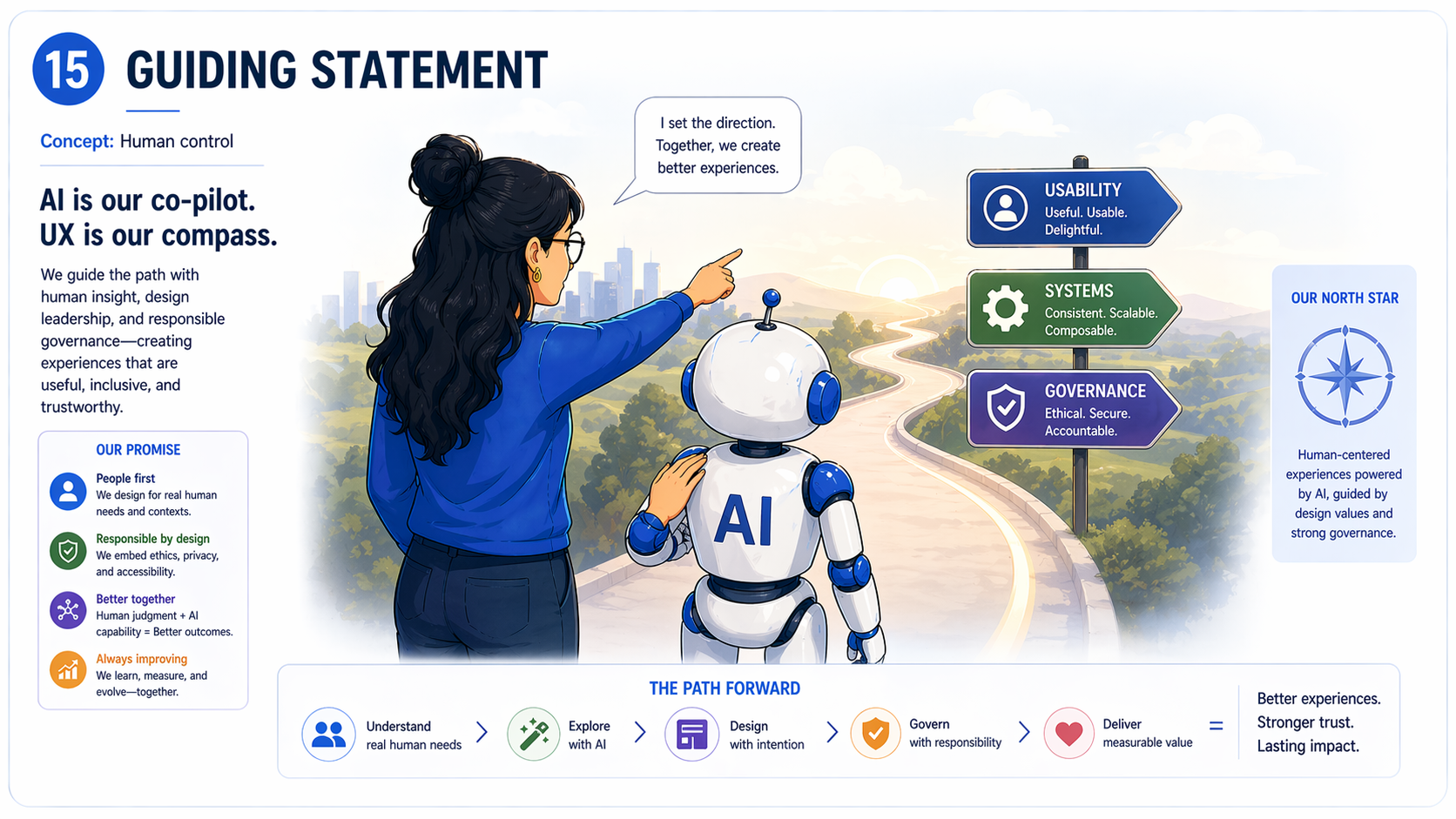
The AI Adoption Playbook was created to help UX, product, and delivery teams understand how to use emerging AI tools responsibly inside a large enterprise environment. The goal was not to encourage unrestricted experimentation or treat AI as a shortcut for design judgment. The goal was to create a practical operating model that helped teams explore new capability while staying grounded in user needs, accessibility, governance, security, and product quality.
The playbook helped teams think through where AI can help, where human judgment needs to remain central, what kinds of work are appropriate for exploration, and what should not move toward production without review.
Key areas included prompting structures, evaluation criteria, exploratory versus production use, deterministic versus probabilistic systems, human judgment checkpoints, and governance conversations with product, UX, engineering, security, and leadership.
Workshops & Training
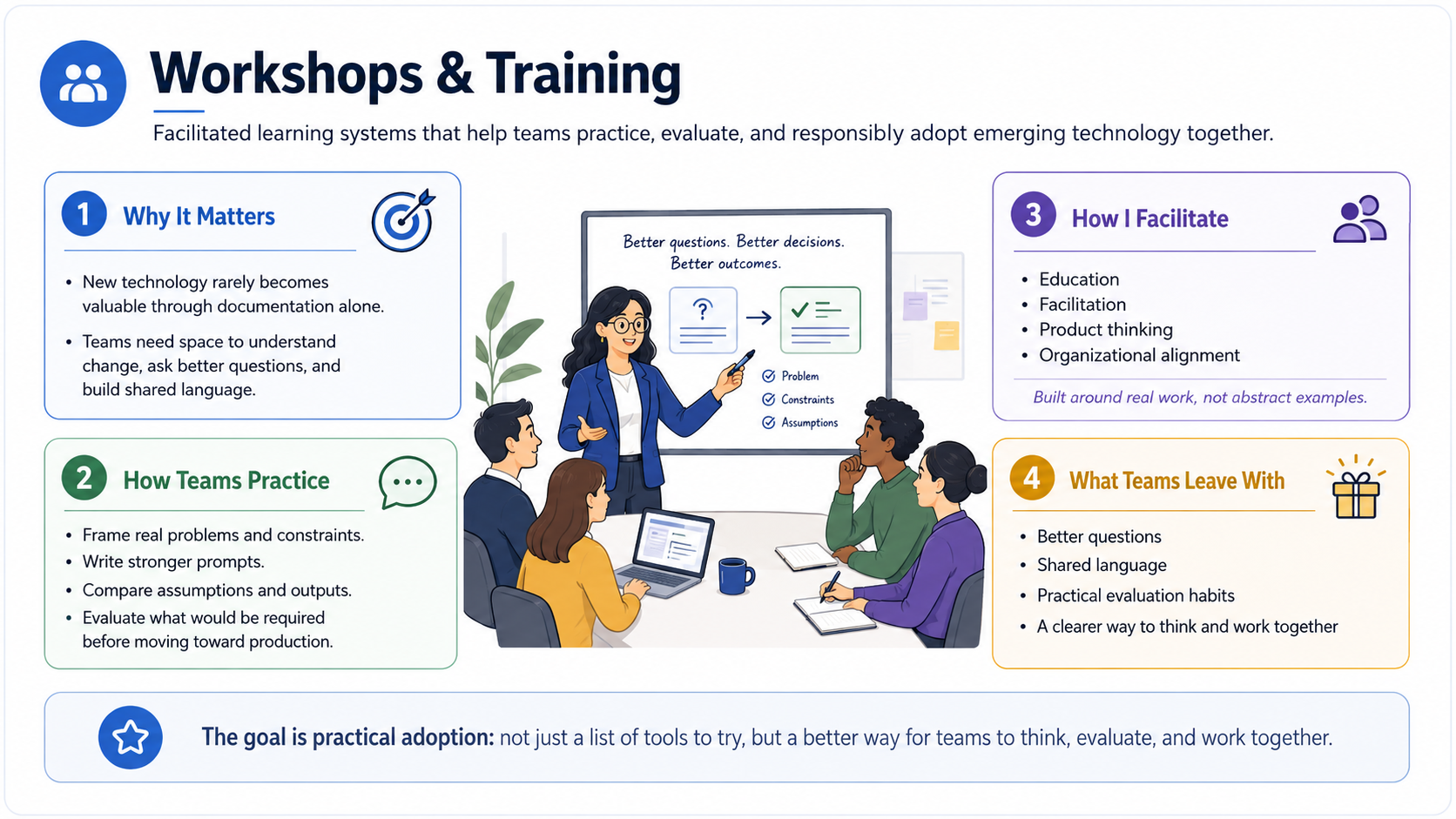
Facilitated learning systems that help teams practice, evaluate, and responsibly adopt emerging technology together.
Workshops and training have become an important part of my work because new technology rarely becomes valuable through documentation alone. Teams need space to understand what is changing, ask better questions, test ideas, compare assumptions, and develop shared language around how the work should evolve.
The strongest sessions were built around real work instead of abstract examples. Teams practiced framing a problem, writing stronger prompts, evaluating outputs, and deciding what would need to happen before anything moved closer to production.
This work is part education, part facilitation, part product thinking, and part organizational alignment. The emphasis is practical: helping teams leave with a better way to think and work, not just a list of tools to try.
Deterministic vs. Probabilistic Systems
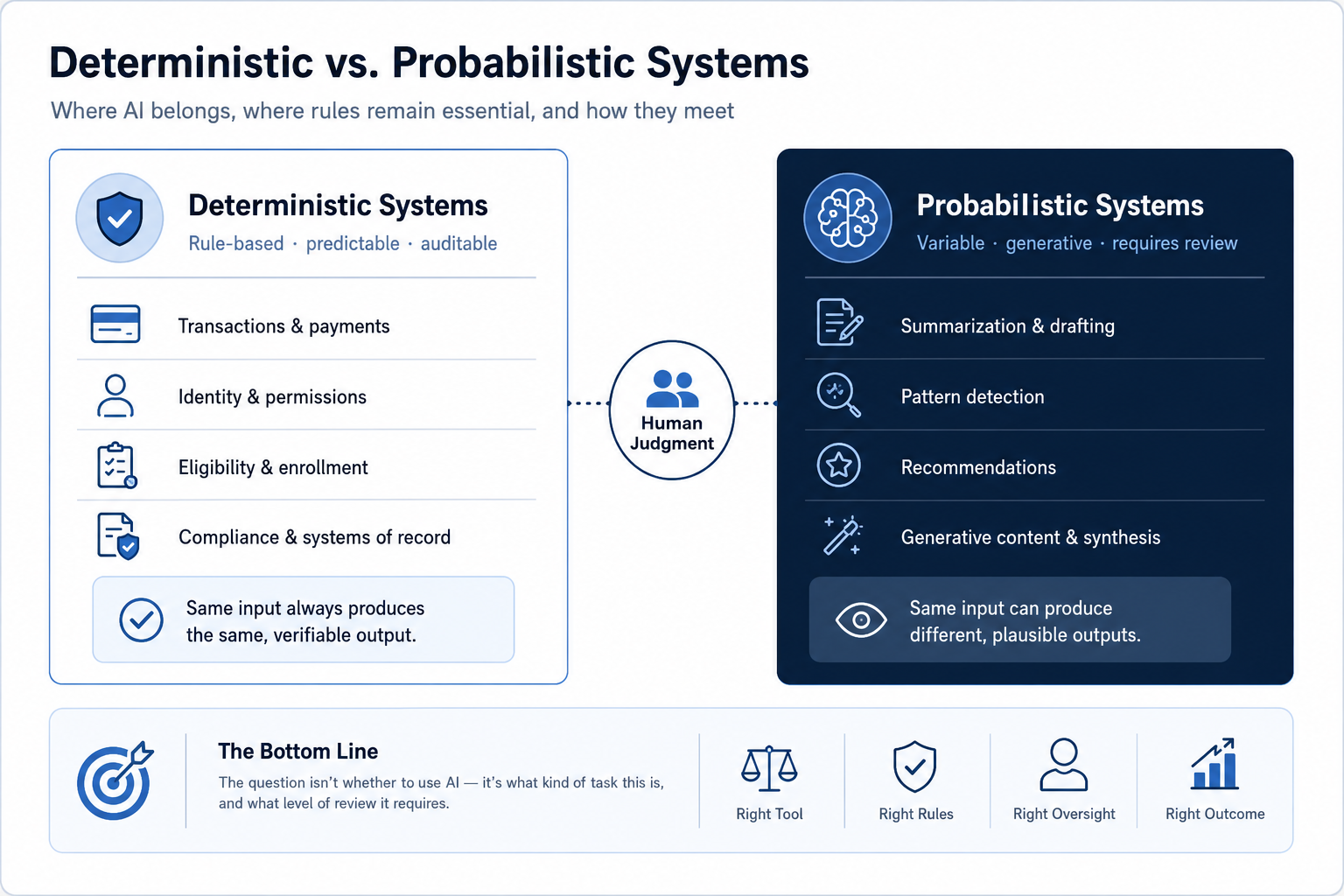
A model for deciding where AI belongs, where traditional systems remain essential, and how hybrid systems should work.
One of the most useful ways I’ve found to explain AI in large organizations is by distinguishing between deterministic systems and probabilistic systems.
Most enterprise software has traditionally been deterministic. A user takes an action, the system follows a defined rule, the database updates, and the result is predictable, repeatable, and auditable. These systems are essential for transactions, identity, eligibility, enrollment, compliance, payments, permissions, and other areas where consistency is critical.
AI systems behave differently. They can infer, summarize, generate, compare, recommend, and surface patterns, but their outputs are probabilistic. They can be useful, but they require context, evaluation, and human judgment.
This framework helps teams move beyond simplistic AI conversations. Instead of asking whether AI should be used at all, teams can ask what kind of task they are dealing with, what level of variation is acceptable, where human review is needed, and what kind of control or evidence the user requires.
Why This Work Matters
AI adoption is not only a technology problem. It is also a people, process, trust, and governance problem.
Frameworks help teams slow down enough to think clearly while still moving forward. They create shared language, clarify risk, support better decisions, and help organizations explore new greenfields without losing sight of users, quality, governance, and trust.
For me, this work continues a long-running thread: helping organizations make sense of new technological capability and translate it into practices people can actually use.